This essay is in response to a recent question I received, and although I have responded to similar queries on an individual basis, I decided to synthesize the answer into a larger piece. It transformed into something a little more autobiographical, with the figural subject as the general point of focus.
“I've always been curious about your figures in your paintings. Why women? Are they specific people?”
It’s a very good question, and I suppose it’s time I put my definitive answers out here as a written piece, because I do get asked about this every so often (usually by an astute person).
Insofar as my awareness of classical feminist discourse in art is concerned, I have been professionally educated on the topic. I’m also aware that there is a small-but-vocal contingency with a radical lens on the idea that male artists should no longer paint women. There is a part of me that fully understands why such a perspective exists, but my critical thinking mind knows that this is big-time gatekeeping. Creatively, that’s nothing less than a slippery slope to unchecked censorship. In my Visual Culture classes, I have used this article (and a couple of others) for a discussion tool regarding this very topic:
https://www.thecut.com/2018/04/can-a-male-artist-still-paint-a-female-nude.html
[n.b. - This may be behind a paywall, so if you are unable to read it, I recommend copying the URL and going through archive.ph]
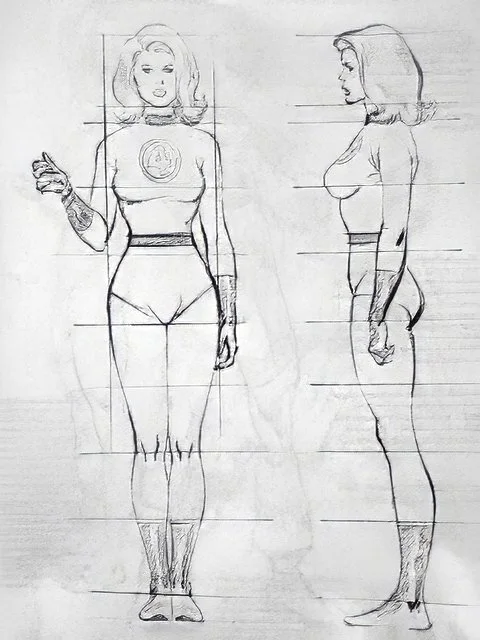
A John Buscema tutorial inside How To Draw Comics the Marvel Way — Stan Lee and John Buscema, 1978
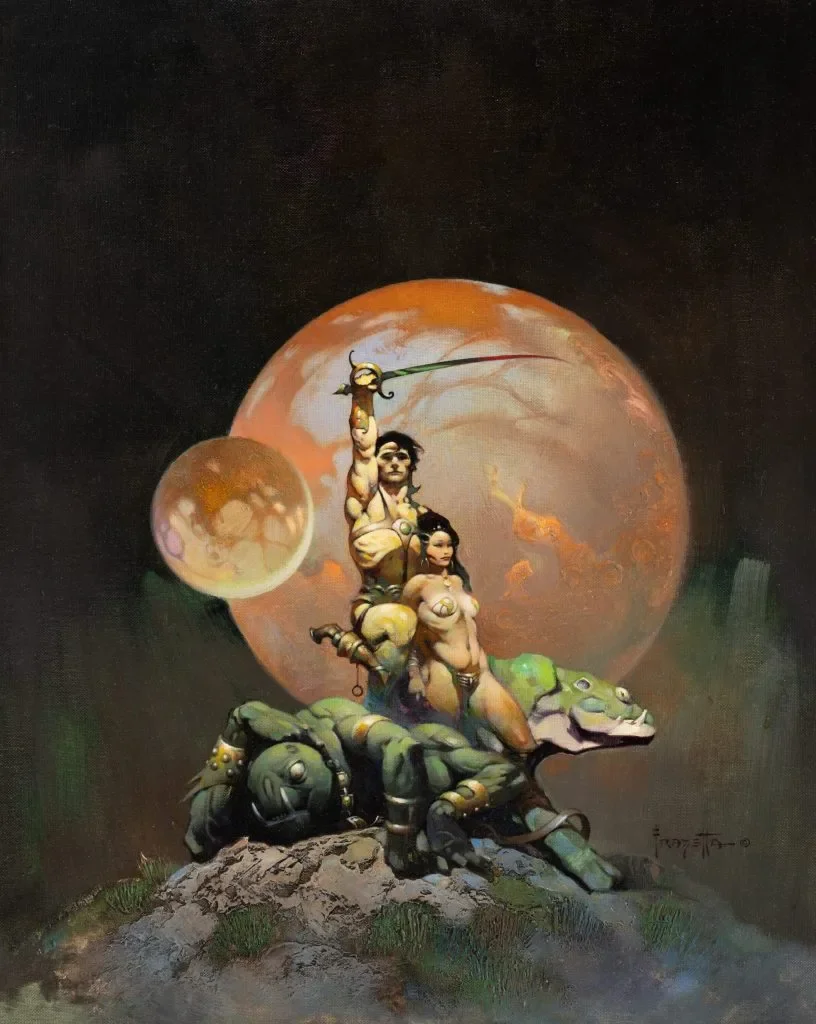
Frank Frazetta cover art for Edgar Rice Burroughs’ Princess of Mars, 1970. (original oil on canvas painting, 20 x 16 in. currently at the George Lucas Museum of Narrative Art)
My personal art history comes from a place that is more illustrative than contemporary. I grew up surrounded by comics and pulpy sci-fi/fantasy imagery, much of which leaned WAY into the scantily clad, hyper-stylized, impossible beauty-standard level (sometimes abstract, thanks Rob Liefeld), depictions of women. Those standards in question remain fictionally unreachable in a human realm. Interestingly, there was always perhaps a tacit acceptance of such (even now, within the fanbase - to a degree) due to the non-real/hyperreal context of the genre. Certainly, the visuals pushed past the point of absurdity (see again, Liefeld, or Milo Manara’s infamous Spider-Woman cover). Now, combine this with the fact that I grew up a repressed Catholic schoolboy raised without a mother. My household was a place where masculine hetero ideologies reigned supreme and yet were inexplicably unspoken. As a result, the female figure was relegated into representations of comic fantasies or holy virgins who could give birth to a god. Both are equally fantastical - the latter is just especially weird, if we’re being objectively honest.
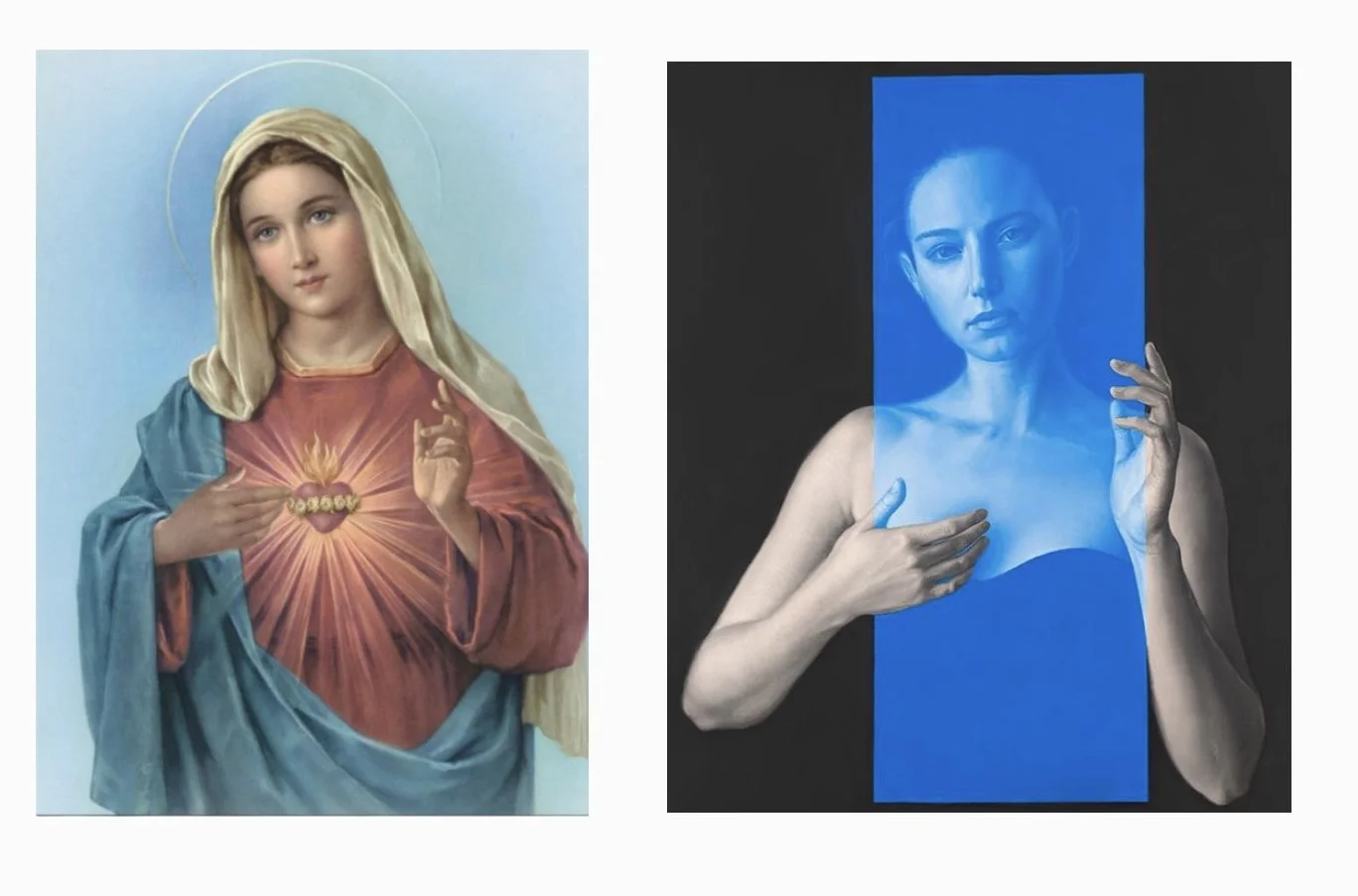
Left: Typical Mass Card of an Immaculate Heart of Mary figure. Artist unknown
Right: Meditora, oil on panel, 24 × 20 inches, 2023
But, not only did I grow up, my worldview of art began to expand, and my maturity with it. The technically difficult nature of drawing the nude figure from life in undergrad (with many genders & many body types) gave me a much more grounded idea of the human body - and in far more objective terms. Additionally, In my art historical studies, I learned the true origins of the figural beauty standard, with the male figure being the original archetype (the Apollonian construct), and then through a philosophical shift during the Classical period, it moved to the female figure (the Dionysian construct). Since that time, for what it’s worth, the female figure has been on quite an historical journey – unfortunately and ultimately becoming instrumentalized and commodified by our Western, phallocentric, misogynist, capitalist system. A great deal of agency was taken away through these actions; the female form became object and objectified.
I grappled with these ideas a great deal in my masters program, looking to feminist art writers like Linda Nochlin and Carol Duncan for some guidance and context. When I came to a fuller understanding of what this all meant, it gave me pause. For a time, I abandoned figuration altogether in order to sort out what painting could mean to me without it. I achieved some success in that exploration. But the success came out of my understanding that paint on a surface was not the thing itself. It is the intentionality of the artist, through the conduit of representation, that gives the painting any sort of meaning or purpose (or agenda, if you will). So whether it’s a quotidian painting of a teapot, a portrait of a specific individual, a New England landscape, or a nude female figure standing on a dais – what those things might mean are not necessarily contained by the representations themselves. I came to understand that the “things“ in a painting are sublimations or allusions to something else. At least, they are when the artist has a solid grasp of critical theory. If not, then they end up in a prosaic loop, beholden to didactic meaning; they are “tendentiously real,” to paraphrase Theodor Adorno.
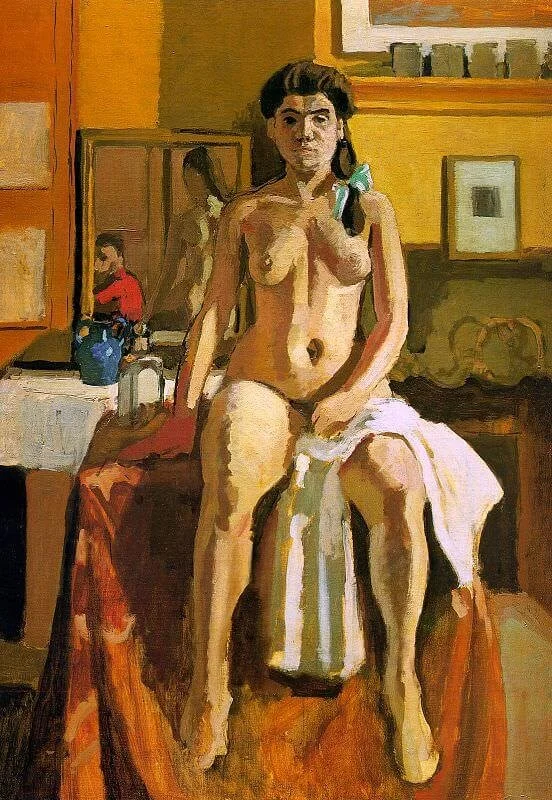
Carmelina - Henri Matisse, o/c 31 x 25 inches, 1903
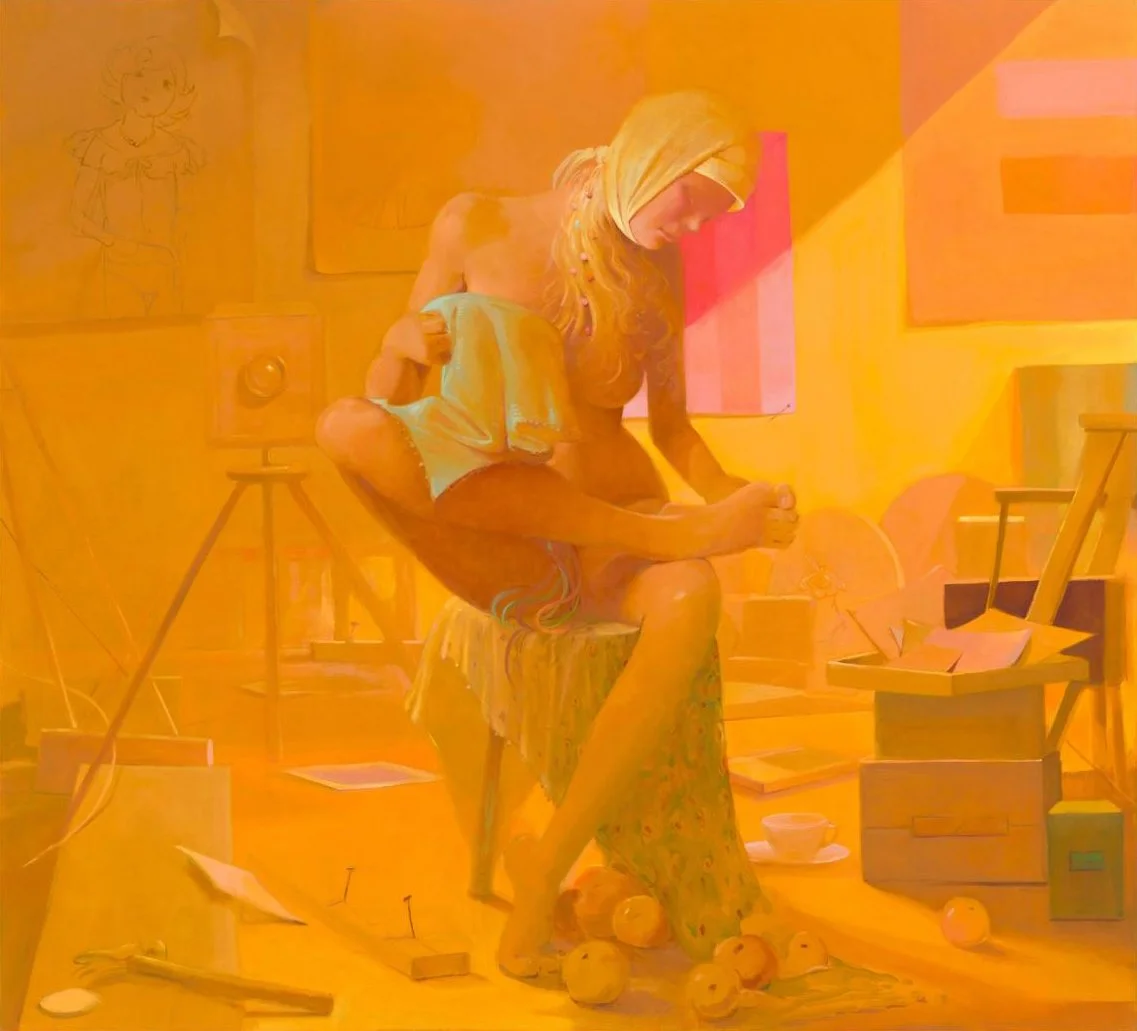
Yellow Studio - Lisa Yuskavage, oil on linen, 70 x 77 in, 2021
And so, I ended up returning to the female figure as a foundational principle within my oeuvre, navigating back to my origins. But at this point, I understood the female figure as no longer merely an archetype of beauty — she had transcended into the epicenter of a new narrative to be put forward as a bulwark of the painting itself. In all honesty, who wants a male character as the focus of any story these days? To use a male archetype as the centerpiece of a narrative feels regressive at worst, or at the least, akin to mansplaining. I would much rather embrace my Jungian anima, and represent my thought process, narrative direction, and perspective via a feminine ambassador.
That in mind, an aspect of my intention is to pay homage to a more honorable idea of beauty standards, even though there’s definitely a contemporary look to my figures; I am painting in 2026, after all. Broadly speaking, there’s really an overarching, simple idea at play: Peter Schjeldahl (NYT critic) once said that the primary function of painting is to improve the wall upon which it is hung. I understand the decorative aspect of this. It was already ingrained in my skillset to craft objects that (most) people will embrace as something beautiful; it’s inherent in my process. But that allows for a “hook,” if you will. Just the look of the thing is designed to promote engagement. Reading into what other meanings the paintings have to offer requires a viewer to lock in. Making aesthetically pleasing paintings can only help with that.. but that is only the first step.
No surprise that, as a cisgender hetero male, I see women as beautiful. Since these are my paintings, the figures reflect a “type” of beauty to which I am personally responding. Regardless, it’s important to note that this response on its face is a very unsophisticated and prosaic aesthetic (and even offensive to some if presented in such one-dimensional way.). I do not wish to be simple or boring here. I want the images, in turn, to reflect what is around me (and/or us) outward in a somewhat abstracted narrative, subverting the veneer of the prosaic. This is why I “problematize” the paintings with oblique and/or allusive narratives, made more complex through my color choices and transparent shapes moving in and out of the picture plane.
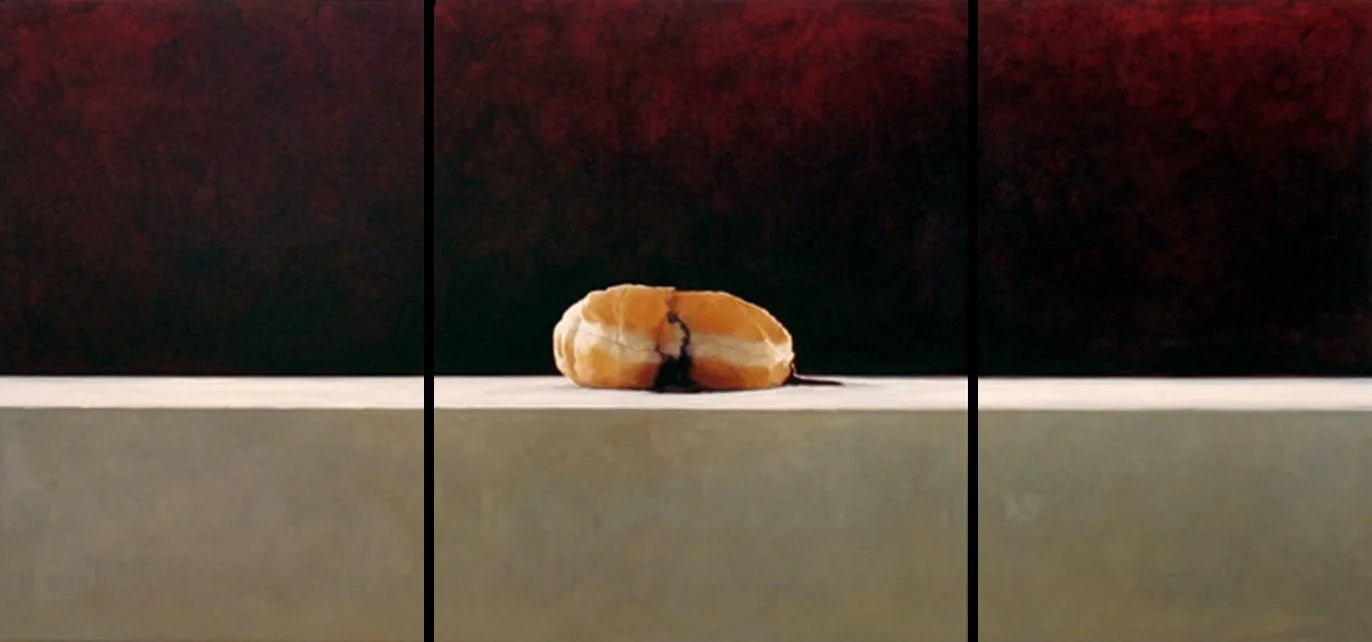
Circle - Emily Eveleth, oil on three canvases, 72 × 155 inches, 2008
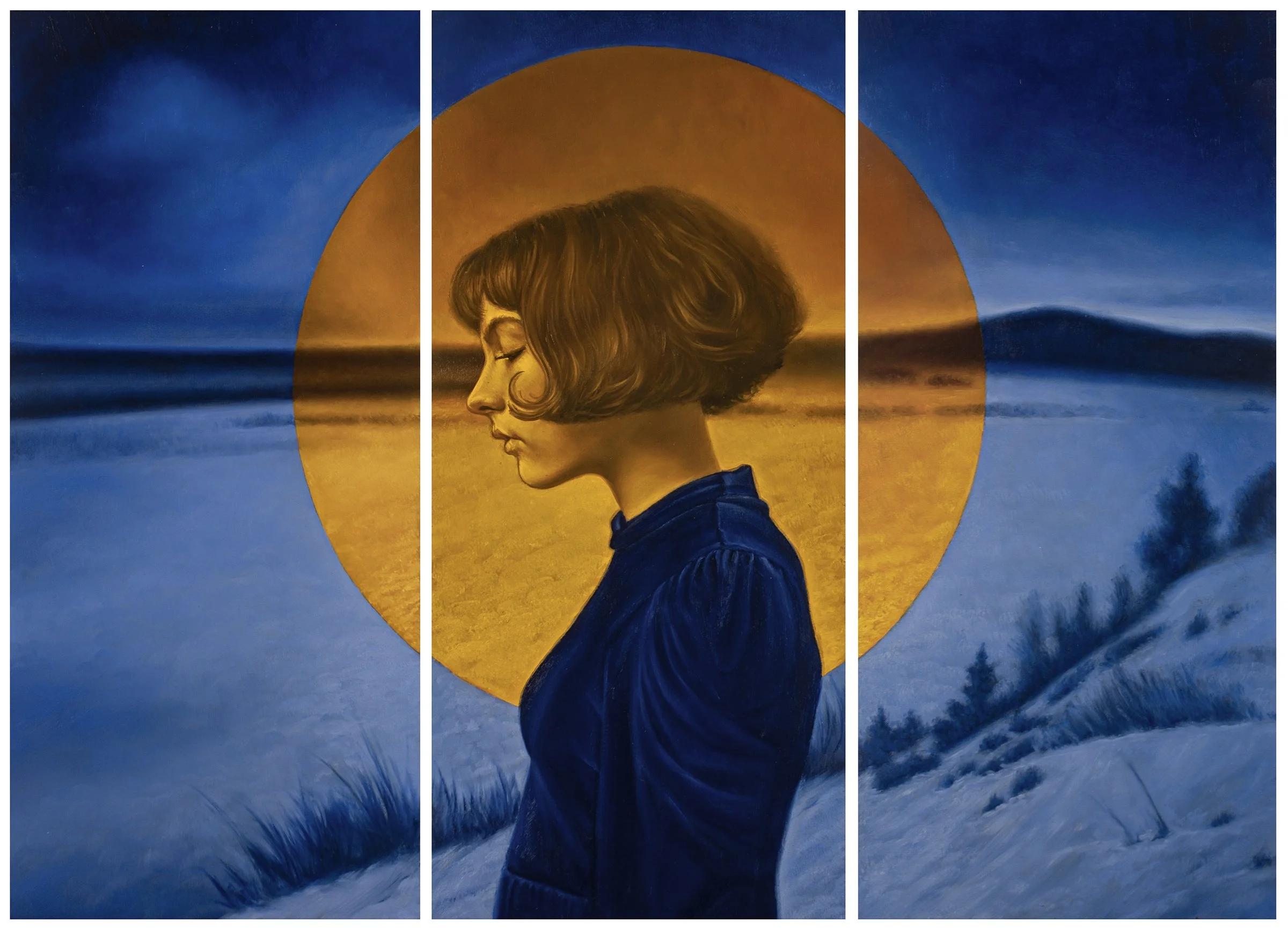
Calefacia - oil on 3 panels, 20 × 30 in, 2024
And therein lies the intentionality. I’m blending the personal, the historical, and the contemporary all together, with the female figure as the cornerstone for my ideas. There is a conventionality in there, for sure: these figures are depicted as white, young, and conventionally attractive. I know it is through my own lens that I see this as “neutral.“ In terms of broader society, this is not neutral… but it is also not regressive, nor it is transgressive. I have already researched and written about Buchloh’s “cyphers of regression,” and what I do is decidedly not that.
Even with the best of intentions, were I to depict an older woman, woman of color, a larger woman, a person who presents as trans/genderfluid, or anyone with a more specific look/demographic in terms of a visual presentation (this could certainly include men, too), the painting’s narrative changes, and it becomes much more about that specificity of choice. The chance to imply open-ended meanings gets buried by that very forward-facing specificity. If I were to paint people with such particularity, they become portraits, or, more likely, a commentary/critique on the race/gender/ethnicity of the person depicted. My intention is very much not about those things. To fall unintentionally into that arena would reveal a dearth of criticality on my part. I don’t have the wherewithal (nor the right) to comment on those topics in my work. I’d be peppered with questions FAR more pointed and complex than the basic question being asked at the beginning of this essay. It would become my mandate to do new research, become far more educated on the subjects, and ultimately end up moving in a completely different direction in terms of what my paintings mean, especially to me. In other words, I would need to undergo a dramatic shift in intentionality — a shift based upon an external rather than internal mandate. In my opinion, that disconnect never makes for good art.
